
Navigating to a lagoon is never annoyed, even for experienced browsers. This delicate manoeuvre, often indispensable to access a protected anchorage or a paradisiac atoll, requires rigorous preparation, precise coordination and a real capacity for anticipation.
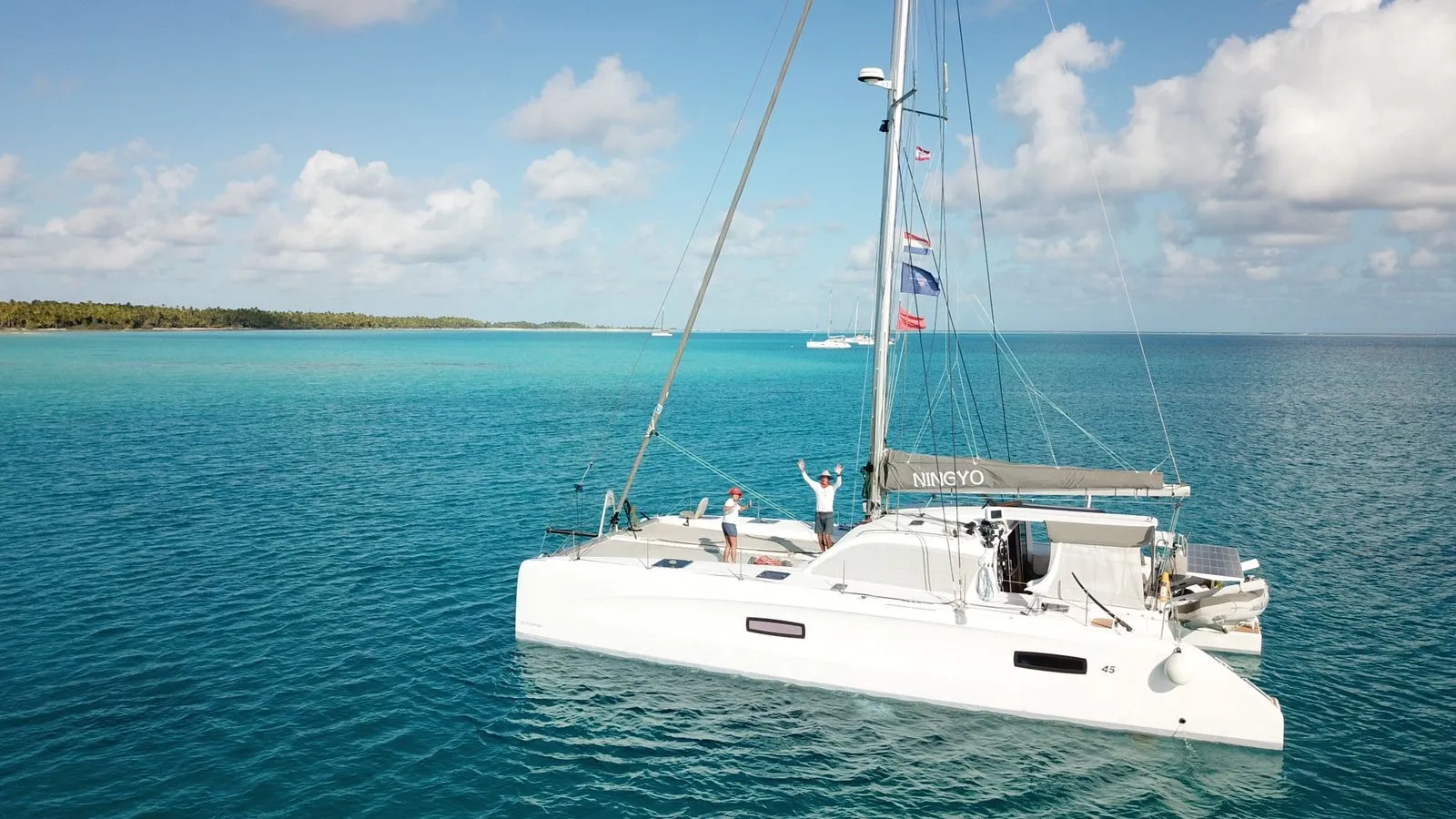
It is based on the valuable experience of Rob and Hanneke, owners of the catamaran Outremer « Ningyo »that this article has been drafted. Having travelled around the world as part of the GLYWO 500 (Grand Large Yachting World Odyssey), this team of experienced sailors shares here its tips and best practices to achieve a safe lagoon entry.
Their experience, gained through passages in many lagoons around the globe, is a valuable source for any catamaran navigator.
Here are the keys to secure your navigation in lagoon and avoid the most frequent errors.
Why entering a lagoon is a delicate maneuver
Specific hazards to navigation in lagoons
Tropical lagoons have an environment as enchanting as it is potentially trapous. The shallow depths of the passages can mask outcropping corals, invisible at high tide. The residual swell from the offshore sometimes complicates the entrance, as does the strong current that evacuates through a narrow passage at descending tide.
Another feature is that these areas are often poorly or poorly mapped. Many passes are only partially on electronic or paper maps, and hydrographic surveys can be several decades old. It will also be necessary to take into account the influx at the entrance of the lagoon, as sailboats are usually not allowed to sail at several times.
Pass features: depth, current, visibility
Each pass is unique. Some are accurately marked, others are only shown to the attentive eyes who can read the shades of water colours. The current can be turbulent, sometimes against the tide, influenced by prevailing winds, the swell accumulated inside the lagoon or the underwater configuration of the reefs.
Visibility plays a crucial role. A shaved or back-lit light makes it almost impossible to read the background. Under these conditions, any sand or coral bank can go unnoticed, even at low speed.
Why catamarans are both advantaged and vulnerable
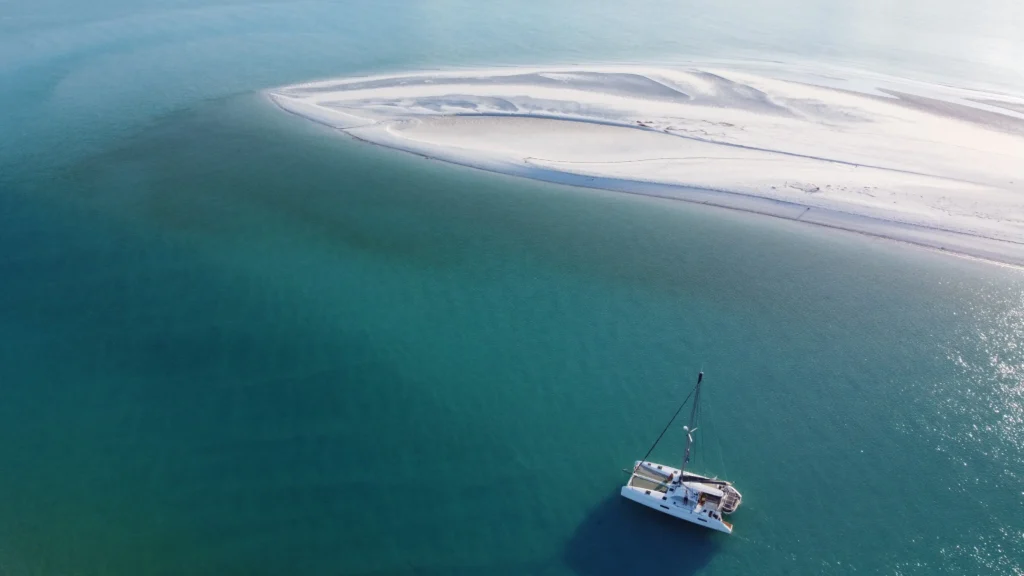
The catamaran has an obvious advantage in shallow waters: its low draught allows it to sneak where monohulls would dare venture. Its low speed manoeuvrability and twin-engine propulsion are assets in fine approach. A quality which is therefore found in Outremer, Allures, or Garcia.
But this ease can be misleading: the width of the boat leaves little margin in a narrow or tortuous passage. Finally, the frontal visibility is sometimes reduced, which makes it necessary to have an observer with a bow. However, navigation is also possible alone, only more difficult.
Preparing for entry into a lagoon: the essential steps
Weather and tide verification
We do not enter a pass without knowing precisely the state of the sea, the direction and strength of the wind, nor the hour of the current overturning. It is strongly advised to target the hours close to lethal, ideally at rising tide. This window reduces the suction effect to the offshore and offers a safety net in case of failure or error of trajectory.
Moreover, thanks to the technical training provided by Grand Large Services, you can learn how to combine weather and real conditions. A good weather forecast also predicts the possible presence of residual swell or grains disrupting visibility.
Study of cartography and nautical guides
One source is never enough. It is recommended to cross information from paper maps, electronic mapping software such as Navionics, satellite images and feedback from other browsers. Data from SHOM, Navionics+ or applications such as OvitalMap may provide additional details.
Finally, local nautical guides or boaters' blogs often provide practical advice or updates missing from official publications.
Crew briefing and role of the observer at the bow
A lagoon entrance is usually done as a team. Before the approach, a briefing should refer to the roles: who observes, who bars, who remains attentive to mapping. The forward observer is crucial. It must be equipped with polarizing binoculars, clearly communicate with the bar, and be able to identify dark spots, color variations or water turbulence.
Useful on-board devices: sounder, mapping, twins, etc.
A reliable prober is a basic tool, as is a deported tablet with active mapping, an independent GPS and an AIS to spot other ships. In the case of formed sea or reduced visibility, the radar may supplement the situation analysis. Polarizing binoculars are particularly useful for reading contrasts in water, avoiding reflections.
Approaching: what reflexes to adopt in catamaran
- Reading water: spot colors, corals, breakers, waves and their height
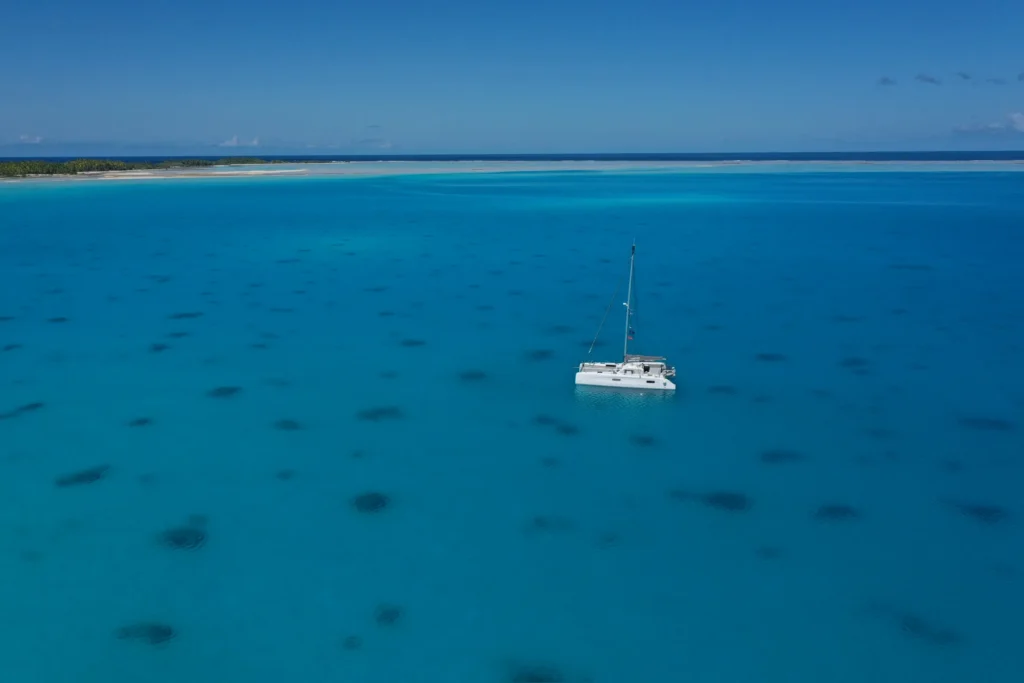
Knowing how to read water is an essential marine art. Dark blue is synonymous with depth, turquoise of areas to be monitored, while beige or white reveal shoals or sand. Dark spots may indicate coral or algae. Breakers are also valuable indicators for identifying outcropping reefs. « The height of the waves should also not be underestimated, since the higher they are, the lower the depth of the water » entrusts Rob to us Outremer Ningyo.
- Use speed wisely
It is necessary to move slowly, but always keeping enough to keep the manoeuvrability. Too low a speed makes the boat unreactive; It reduces reaction time. It is essential to always keep the ability to turn back if necessary.
- Keep a folding solution in mind
A clear plan B is an indispensable safety: offshore waiting loop, other anchorages, or even postponing entry. In some areas, patience is the best manoeuvre: waiting for better light, a more favorable tide or a calm swell.
- Do not overestimate electronic aids
Digital tools are valuable complements, but they do not replace direct observation. Electronic cards can be staggered by tens of meters. Satellite images do not give depth, and GPX traces, sometimes shared between boaters, must be used with discernment. Their validity depends on the type of boat, the time of passage and the conditions encountered.
What must be avoided
Several errors frequently occur when entering a lagoon. The first one is to enter it against the day. This is the best way to lose any ability to read water surface. The golden rule is simple: light in the back, ideally in the morning or early afternoon.
The second error is that navigate without active probe or bow observer. Even in clear waters, an isolated coral potato may arise at the last moment.
Third pitfall: to trust a GPX trace blindly. Even if it has been shared by another sailboat, there is no guarantee that it corresponds exactly to your configuration or the conditions of the day. Finally, to engage without plan B, in a poorly known pass, amounts to taking an unnecessary risk. If doubt exists, it is better to expect better light, a more favourable tide or calmer conditions.
Once in the lagoon: continue to remain vigilant
Navigation in shallow waters
The entry crossed, caution must remain. Navigation often takes place in less than two metres of water. Keep the speed down, keep the observer active and monitor the prober. Any relaxation can lead to a failure on coral or hard sand.
Choose safe anchorage area
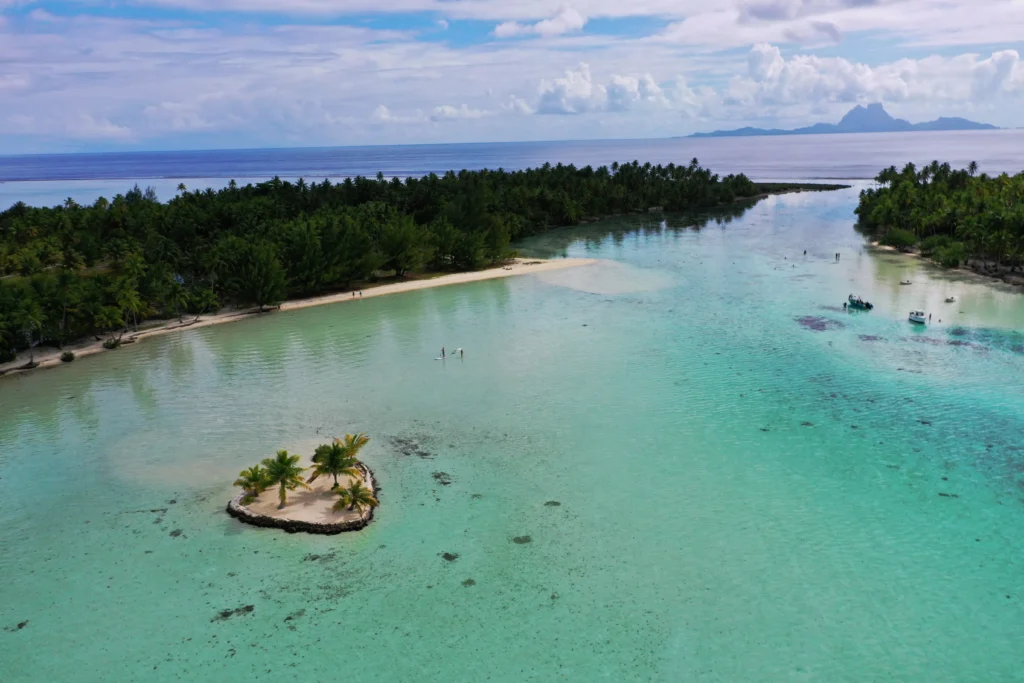
It is preferable to Wet in a sandy, clear area, avoiding coral potatoes. The anchoring will be better, and the environmental impact limited. The verification of wind exposure and the consultation of weather forecasts are also essential to ensure a safe anchorage. Rob and Hanneke tell us about the one who particularly marked them, the lagoon of tahas and Raiatea in French Polynesia. Since it is a very coveted lagoon where sailboats sometimes stay for several days without coming out and take advantage of it to visit the two nearby islands.
Anticipate lagoon output if weather changes
Finally, one must always have in mind the next hour of tide, especially if one plans to leave. A change in weather can make a pass impassable or dangerous. Daily monitoring of conditions is therefore essential.
Conclusion
Entering a lagoon by sailboat is a unique and exciting moment... but it requires method and humility. In catamaran and monohull, prudence, anticipation and observation are your best allies. Thanks to a good preparation, a crew briefing and a fine reading of the conditions, this manoeuvre becomes a pleasant routine, provided that it is never trivialized.
➡ To go further: discover our articles on Orc attacks, how to accommodate a crew or the question of Health Blue Water Sailing.
➡ See also the resources of the SHOM or Nanoonics for reliable maps in the tropical zone.